


Over the summer, Darrow, the legal intelligence company built to surface hidden legal risk and turn it into action, detected an anomaly in the code of a fertility tracking app.
On the surface, nothing seemed unusual. The app’s latest update notes mentioned only “general performance improvements” and “minor bug fixes.” But Darrow’s legal intelligence infrastructure flagged something unexpected: the app started transmitting unique device identifiers to an advertising partner that was not listed anywhere in its privacy policy.
If true, this would mean that users’ extremely sensitive reproductive data is unknowingly being tracked and profiled to a third party without consent.
At first, the signal did not appear concerning. It was the kind of background telemetry many apps use for crash analytics or ad attribution. Still, Darrow’s system marked it as suspicious. The Legal Intelligence team compared the app’s new code signature to its earlier version, then ran the update through a series of checks: changes in requested permissions, modifications to background processes, and differences in outbound network traffic. This revealed a significant change and potential privacy violation: the app had quietly integrated a new module from an advertising software development kit (SDK) that, according to publicly available documentation, could link identifiers with precise geolocation data and trace users’ routines from morning check-ins to evening updates.
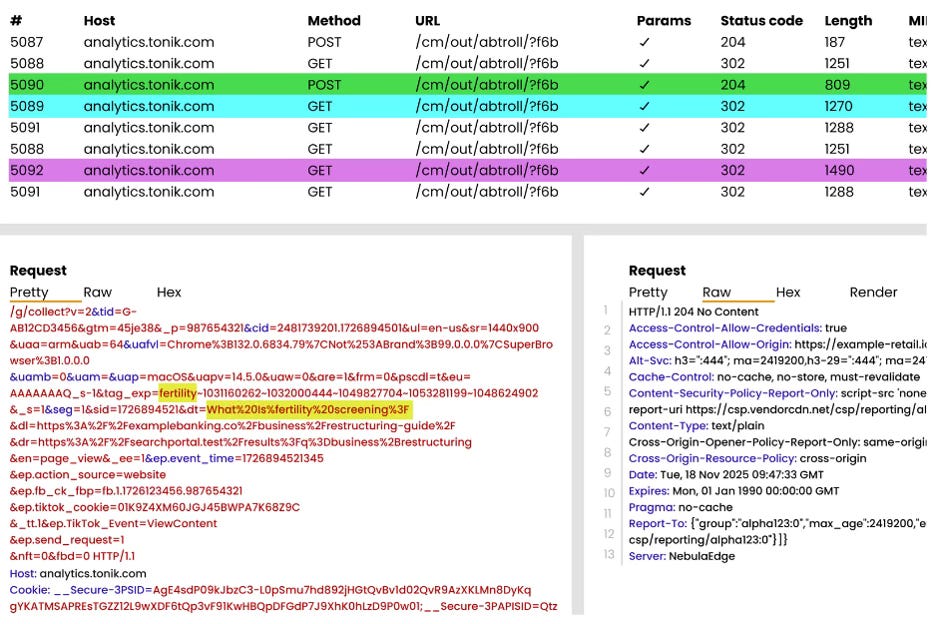
To the average user, this would be invisible. From a legal perspective, however, it raised serious concerns. Analysts reconstructed the data flow, cross-referencing the app’s behavior with recent rulings involving mobile tracking technologies. Combining persistent identifiers and location data and transmitting them to a third party without explicit consent can violate several privacy statutes, including the California Invasion of Privacy Act (CIPA), a state statute that prohibits the unauthorized interception or sharing of communications and data, and often serves as the basis for class action lawsuits.
Darrow automatically flagged the incident as a potential privacy violation and sent it to the company’s privacy intelligence team for legal review. The privacy team began investigating and tracked the timeline of the code changes and confirmed that the new permissions requested access to background location data even when the app was not running. Legal analysts reviewed the information alongside recent court rulings involving unauthorized tracking in mobile applications. The team’s review showed a strong resemblance to earlier cases that resulted in major settlements, particularly those where users had no way to opt out.
Over the following days, Darrow’s legal intelligence analysts mapped the full scope of the issue and analyzed public download data and app store activity to estimate that millions of users had installed the affected version since the update. Each of them likely had their movements and device IDs logged and shared with an undisclosed third party.
Because the data was highly sensitive and the exposure widespread, the incident constituted a serious privacy breach. Darrow’s legal experts identified this as an alleged CIPA violation and translated the findings into a full assessment, including projected damages and settlement scenarios. They assembled a detailed case memorandum with the evidence, legal theories, and impact analysis, and brought it to a leading plaintiff firm. The firm determined the case was viable and filed a putative class action to seek relief for the exposed users.
Through the combination of machine learning, data analysis, and legal expertise, Darrow’s legal intelligence analysts turned a few lines of suspicious code into a potential nationwide enforcement action that could secure relief for millions of people whose most intimate health choices were tracked and sold without their consent.
If successful, the case will send a clear message that exploiting reproductive data for ad targeting carries real financial and legal consequences. This is the power of legal intelligence: turning invisible technical changes into accountability, and shifting power back to the people whose lives and data are on the line.
To learn more about how Darrow uncovers legal violations, check out this article on Darrow’s blog: Using Legal Intelligence to Turn Data Into Justice. For more information about Darrow, visit www.darrow.ai.